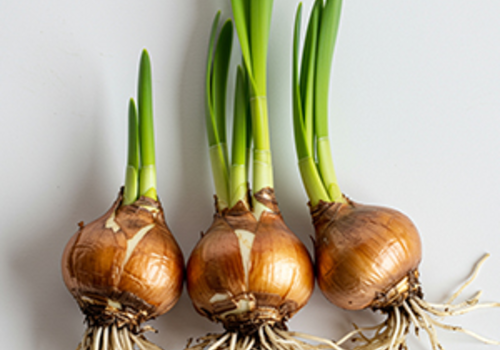
Planting flower bulbs in your garden is a great way to add some colour and the best part is it’s so easy. In this guide, we share everything you need to know about planting bulbs.
How to store flower bulbs?
Check your order is correct and the quality of your flower bulbs is as expected. Store your bulbs in a cool dry and dark place with good air circulation. Planting should be done as soon as possible after the bulbs are delivered.
What soil condition is best for planting flower bulbs?
Soil should not be too wet for planting flower bulbs - it should have good drainage but also good moisture retention as bulbs are not deep rooted. Soil structure can be improved by adding coarse sand or well-rotted organic material. The ideal pH level is approximately 6.5.
Fertiliser is not essential but a dressing of a high potash and phosphate fertiliser such as bone meal or hoof and bone, applied before planting may be beneficial. Take a look at our bulb planting essential here.
How to plant flower bulbs?
Prepare the soil
Remove weeds and loosen the surface. In grassy areas or meadows, lift small sections of turf, tuck the bulbs underneath, and replace the turf for a natural finish.
Check the bulb orientation.
Most bulbs have a pointed end (the shoot) and a flat or slightly rounded base (the roots). The pointed end should face up, towards the surface. Some bulbs, like crocus, are oval with a slight taper – the narrower tip is the top. If in doubt, look for tiny root hairs at the base – that side goes down.
Plant at the correct depth
As a rule of thumb, bulbs should be planted at least two and a half times the height of the bulb and far enough apart so as not to touch each other. Plant your bulbs in small groups of 6-8 bulbs.
Cover and water
Gently replace the soil or turf, firm it down lightly, and water well to help the bulbs settle in.
Planting bulbs within grass areas
When planting of bulbs has taken place in grass areas, mowing should not take place until after the leaves have died off naturally (about six weeks from planting). Do not tie up or knot the foliage as this cuts off food supply.
When should I plant flower bulbs?
It is preferable to plant before the onset of frosts so that rooting can take place quickly. After rooting they are quite frost tolerant.
When planting different types of bulbs it is important to check their specific requirements as some bulbs require different planting times. As a rule of thumb:
- Spring-flowering bulbs such as, daffodils, crocus, hyacinths should be planted between September and the end of November.
- Tulips are commonly planted in November to avoid disease issues.
- Tender summer-flowering bulbs such as, gladioli, and other frost-sensitive summer bulbs, should be planted in early spring.
- Autumn-flowering bulbs should be planted by late summer.
At Boston Seeds, we have a wide range of autumn flower bulbs, take a look at our range here.
What size are Boston Seeds bulbs?
The majority of our bulbs will have a bulb size mentioned (i.e. 10/11cm or 12/14cm) this size relates to the circumference of the bulb.
Caution: Bulbs can be toxic and should not be eaten. Some types may cause skin irritation therefore gloves should be worn.
How we can help!
At Boston Seeds we take pride in excellent customer service. If you're looking to buy some bulbs for your garden take a look at our wide range.
With Next Day Delivery on hundreds of items too, choosing from our extensive range of grass seed couldn't be easier. Ordering regularly or looking for large volumes? Click here to apply for a trade account today - we review all applications within one working day. If you have any questions, then please get in touch.